Horsham windows by house era: what was fitted and what replaces it
Horsham is an old market town with medieval houses on the Causeway, but most of its homes were built in five fairly distinct periods. The dates below come from the Victoria County History of Sussex, which covers the town's growth up to the early 1980s, and from the district's 2015 Planning Framework for the years since. Find your street's period and the window choice mostly follows.
Before the railway: the old town and London Road
The Causeway was the wealthiest street in the 16th and 17th centuries, and its houses were refronted in brick in the 18th century. Brighton Road and London Road were built up by about 1830, with stuccoed terraces such as Brunswick Place. Windows here are timber sashes and casements, often with glazing bars, under Horsham stone or clay tile roofs. Most of this area sits inside the Horsham or London Road conservation areas. Read the conservation areas page first.
After 1859: the railway suburbs
The railway brought semi-detached houses east of the station, on Station Road and Barrington Road, built up by 1896. Hurst Road followed in the 1860s and Clarence Road from about 1884. Wimblehurst Road became a select suburb. These are mostly brick houses with vertical sliding sashes and, on the larger ones, two-storey bays. Outside the conservation areas, a uPVC sliding sash is the usual replacement.
1918 to 1939: council houses and bay-fronted semis
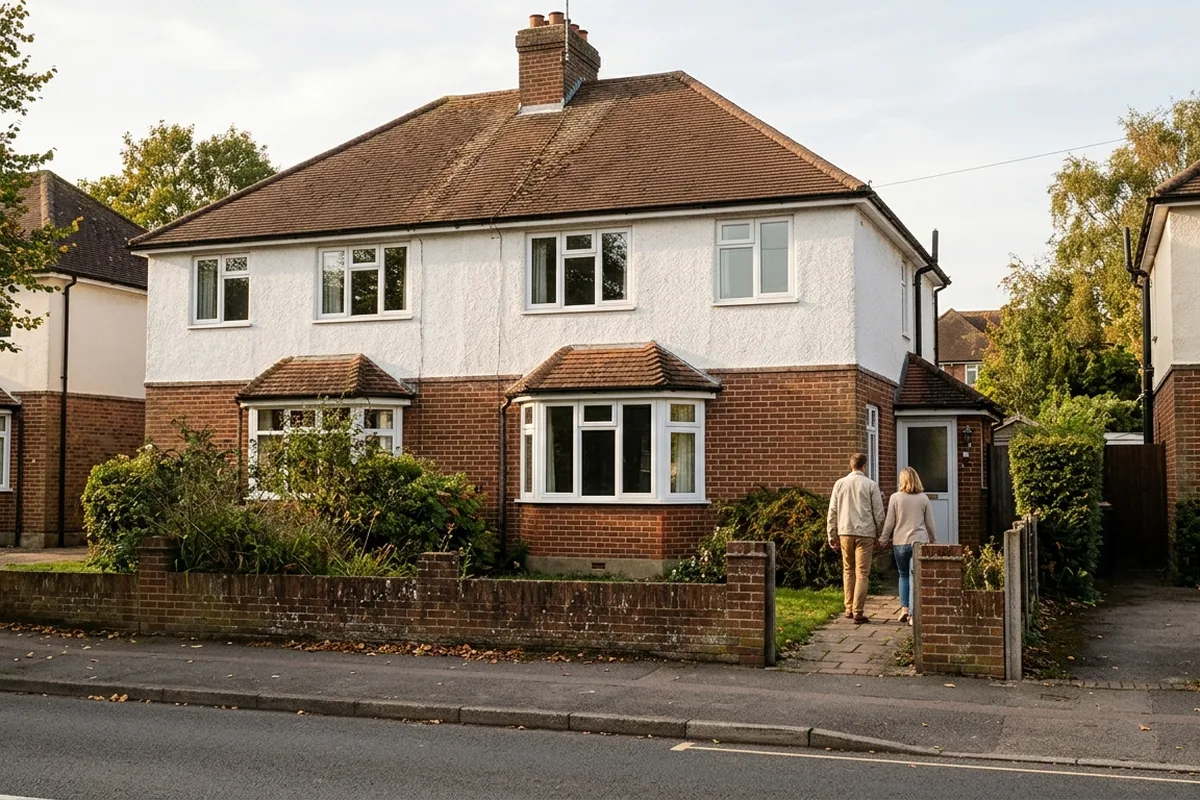
The urban district council built 582 council houses between the wars, many at Oakhill. Roffey and Littlehaven grew fast in the 1920s. The Hills estate along Guildford Road dates from 1925 and Hurst Avenue was laid out by 1932. Expect canted bays, casements with a top bar, and on some houses original steel windows. Bay windows and flush casements suit these houses best.
1945 to the 1960s: the post-war estates
Coote's farm estate north of Guildford Road was laid out with private houses by the mid-1950s. Spencer's farm estate had 141 council homes, and about 180 council houses went up between Brighton Road and Highlands Road by 1955. The Needles estate was laid out from about 1955. These houses have plain openings without bars. A chamfered uPVC casement is the like-for-like replacement and the best value.
The 1970s and early 1980s: the big expansion
North Heath was extensively developed in the 1970s, some of it by the Greater London Council. The Highlands farm estate added large executive houses. Hills Farm was sold for housing in 1972 and building was still going on in 1980. This is the period that most needs replacing now: houses of these years have wide windows, and many had their first double glazing fitted in the 1980s. Wide glazing suits slimline aluminium, while the smaller terraced houses do well with chamfered uPVC.
Since the 1980s: Holbrook and the new neighbourhoods
Holbrook is mostly late 20th-century housing. The 2015 Planning Framework then allocated at least 2,500 homes north of Horsham and recorded about 2,000 permitted west of the town. Houses this new rarely need windows yet. The exceptions are flats, where tilt and turn windows help with cleaning and escape, and the oldest Holbrook houses, which are now reaching the age of the 1970s estates.